On joy, rest, and what I learned from the sisters of Plum Village
November 16, 2026
This past summer, while attending the annual family retreat at Plum Village, our family had the opportunity to offer our farmhouse in the northern Ardèche to sixteen sisters from the monastery for ten days of vacation.
We were in the middle of preparing for our move to Paris, hoping ourselves to have a short, restful break before beginning the next chapter of our lives. It had been a busy summer, and like so many transitions, our bodies seemed to need time to catch up with everything we had experienced and everything that was still to come. We needed to find ourselves again in space and time.
Still, I was excited to share our home with the sisters.
Plum Village, founded by the Vietnamese Zen master Thich Nhat Hanh, is a mindfulness practice community rooted in the tradition of engaged Buddhism. For our family, its summer retreats have become an important part of our lives. We have returned year after year to practice, reconnect, and experience the generosity and care of the monastic community.
The seeds planted in our son, and in our own lives, have sprouted in unexpected ways. The support and love we have felt while in the care of the sisters and brothers have spilled over into our everyday lives.
The sisters were arriving after more than eight weeks of offering retreats and caring for others. For much of the summer, they had welcomed families and individuals into their community, prepared meals, shared their living spaces, and, in some cases, given up their own rooms to accommodate guests.
Their days had been devoted to offering refuge, spiritual nourishment, and the opportunity for others to rest and reconnect with themselves.
I knew something of what that generosity felt like from the receiving end. Our family had experienced it summer after summer.
Now it was their turn to be cared for.
I began going through each room, preparing the house with care, imagining their time there and hoping it would be nourishing. I wanted our home to be a place where they could put down their responsibilities, feel welcomed, and enjoy the freedom of having nothing expected of them.
This felt like a small opportunity to give something back.
Preparing to rest
As the days drew closer to their arrival, the pressure helped us become more organized, but it also made us work harder.
France had experienced an exceptionally hot summer, and the northern Ardèche was no different. Our large above-ground pool still occupied the courtyard, the summer furniture was everywhere, and the house was slowly being dismantled around us.
My husband, Philippe, was finishing projects and preparing the van for our move. I worked through laundry, cooking, cleaning, and preparing the rooms. Between the packing and the lack of sleep, we tried to stay connected to our son and to each other.
Then we learned that the heat had brought forward the grape harvest in our small vineyard.
We would need to harvest the grapes the day after the sisters arrived and the day before we left.
It would be a sprint to the end.
Our harvests are usually wonderful moments of community, ending with a shared meal and a glass of wine from the previous year’s harvest, gathered with many of the same beloved friends. This year, because the harvest had come so early, no one was available.
I hesitated to ask the sisters to participate. They were coming for a holiday, after all, and I was also mindful that they did not drink wine. I wasn’t sure how they might feel about helping to harvest grapes intended for that purpose.
The day before their arrival, I prepared a meal for them, hoping we might have the chance to sit together before leaving.
That evening, we collapsed into bed, our bodies still vibrating with the work behind us and the work ahead.
Sixteen sisters arrive
The following afternoon, while we continued breaking down the pool and preparing the van, we heard the familiar sound of wheels on gravel.
Two enormous vans had arrived in front of our farmhouse.
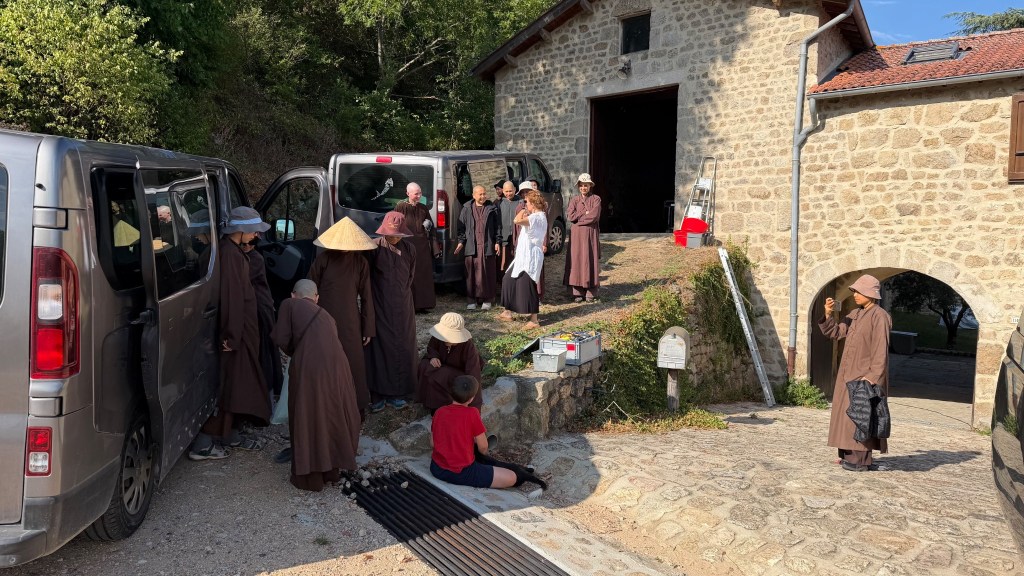
Sixteen sisters poured out, looking a little weary and perhaps wondering exactly where they had arrived, and who this family was that had invited them to an isolated farm in France.
As I began showing them around, Philippe returned to work. Our son, Lino, stepped in as tour guide, and together we introduced them to the bedrooms, kitchen, common spaces, and places where they could camp.
I tried not to overwhelm them with information, although it was difficult not to, given the size of Charpelière.
But the sisters were not deterred.
They were delighted, and delightful.
They wrapped Lino in admiration, marveling at the small Lego creations and large photographs covering his room. They oohed and aahed when I opened the closet filled with extra blankets and pillows. They eagerly chose their rooms and began unloading crates of food they had carefully prepared for their stay.
We tried to give them space, but found them everywhere.
I remember smiling to myself at their graceful presence, continuing to hold the wish that, as they settled in, they might feel the love with which we had prepared the house for them.
Soon, food began appearing.
A little shyly, I brought out the soup, potatoes, and salads I had prepared. The sisters made Thai-style sushi, and before long we were sharing dishes and talking easily around the table.
Some began settling into tents beneath the hundred-year-old cedar tree. Others discovered the table football and began playing with Lino. Still others made friends with the neighbour’s dog.
There was unmistakable pleasure in discovering the house, choosing a bed, and making themselves at home.
Eventually, we went to bed, partly because we needed the rest and partly because we wanted to give them room to settle.
A different kind of rest
The next morning, I rose to find the windows occupied by candles and peaceful faces, the sisters meditating into the mist.
As the sun gradually burned away the fog, breakfast was finished and plans were made.
Most of the sisters headed to the lake. Two offered to stay and help us with the grape harvest.
We were enormously grateful.
Later, we shared a generous lunch, complete with cake and ice cream. I remember being struck by the wholesomeness of their delight, particularly in the small pleasures of the meal.
It brought me back to something about myself.
There have been plenty of moments when I’ve hurriedly eaten a little caramel ice cream, enjoying it while carrying some quiet feeling of guilt. Watching the sisters, I began to consider how different the same experience could be if I simply allowed myself to enjoy it.
A small thing, perhaps. But the ease of their pleasure stayed with me.
That evening, after everyone returned, the sisters prepared a dinner in our honour. There were Thai salads, Vietnamese spring rolls, potatoes, soup, and so much beautiful food.
They offered us gifts and began singing.
We talked about how each of them had come to monastic life and how long they had been there. Stories emerged about old friendships, unexpected reunions, and the distances that sometimes separate members of such a large international community.
As our preparations to leave finally came to an end, we were swept up in hugs, smiles, and sweet expressions of gratitude.
We left them to their holiday.
And then the photographs began arriving.
They came to play
Over the following days, messages appeared with photographs and videos of the sisters exploring the area and enjoying the house.
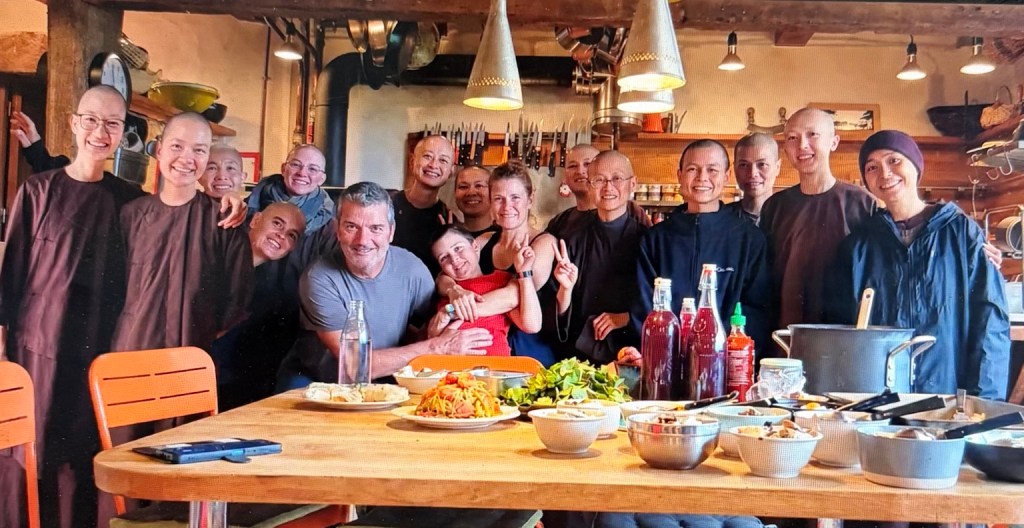
They played games, danced, made music, jumped on the trampoline, spent time with animals, watched films on the big screen, and embraced the pleasures of being together.
They played Jenga and table football. They explored, laughed, and seemed willing to throw themselves into whatever the day offered.
There was something wonderful about the photographs.
Of course, I had hoped they would enjoy themselves. But what I hadn’t anticipated was the wholeheartedness of their joy.
They had come to rest.
And they came to play.
What moved me was not simply that the sisters were having fun, but the freedom with which they seemed to enter into it. There was a willingness to be present, to share space and themselves, and to allow ordinary moments to become occasions for delight.
I felt deeply connected to them through those images, even after we had left.
But something else stayed with me long afterward.
Their response to rest was joy.
And I began to understand that perhaps this was not accidental, but essential.
Joy as nourishment
In the Plum Village tradition, joy is not understood simply as something that happens when life is going well.
Thich Nhat Hanh taught that we can actively cultivate joy and happiness, and that doing so helps nourish us. The practice of mindfulness is not intended to make life relentlessly serious. It invites us to recognize the conditions for happiness that are already available, even while acknowledging suffering.
At the 2026 Plum Village Summer Retreat, joy was explored through play, togetherness, nature, and the simple pleasures of being alive.
This is a distinction that I continue to appreciate.
Joy doesn’t require us to deny what is difficult. It isn’t an instruction to be cheerful, or to replace painful emotions with pleasant ones.
It is something we can make room for alongside everything else.
Psychologist Kelly McGonigal explores a related idea in her book Joy Is a Risk Worth Taking. She describes joy as a resource that helps sustain hope, connection, and meaning, particularly when life is difficult.
One idea from her work that resonates with me is how readily we can dampen our own joy.
We sometimes hesitate to enjoy a moment fully. We worry that pleasure is frivolous, selfish, undeserved, or somehow inappropriate in the face of everything else demanding our attention.
I think again of that caramel ice cream.
How easily a moment of delight can become complicated by a thought about what we should or shouldn’t be doing.
And how different it feels when joy is simply welcomed.
Remembering our capacity for delight
In my work with clients, conversations about burnout often bring us to questions of rest and restoration.
Sometimes people speak about wanting to return to a version of themselves that felt lighter, less burdened, or less preoccupied with responsibility. There can be a longing for something they remember but no longer quite know how to reach.
I’ve been thinking about the possibility that exhaustion isn’t always relieved by doing less. Sometimes, in our efforts to rest and recover, we begin to eliminate the very experiences that nourish us. We stop making time for friends, creativity, spontaneity, and play, considering them luxuries to return to when life becomes less demanding.
Psychologist Anna Katharina Schaffner describes this pattern in her article How We Make Burnout Worse. She argues that we can inadvertently deepen our exhaustion by cutting out the activities that replenish us.
Perhaps recovery asks us not only to consider what is depleting us, but also what is missing.
When these conversations arise, I sometimes think of the sisters.
I think about their enthusiasm, their playfulness, and their uncomplicated pleasure in being together.
We may need sleep, solitude, fewer obligations, and time to recover. But perhaps we also need opportunities to laugh, to play, to share something beautiful, or to experience a moment without asking it to serve any other purpose.
Joy is not a cure for suffering or burnout. Nor is it another task to add to an already demanding life.
But perhaps it is something essential that we can lose sight of when seriousness and responsibility begin to occupy too much space.
I had offered our home to the sisters because I wanted them to have somewhere to rest. I hoped to give back a little of the nourishment our family had received through the years.
What I hadn’t anticipated was what they would leave with me.
Long after the house was emptied and our family settled into our new life in Paris, the images of their holiday continued to bring me happiness.
Sixteen sisters, far from their usual routines, finding pleasure in one another, in games, in music, in a house that had been offered with love.
They had come to rest.
They came to play.
And they reminded me that joy is not something we have to wait until we are rested to experience.
Sometimes, joy is part of how we rest.
I find myself returning to a song the sisters sang for us during our last evening together. It is a familiar Plum Village song, Happiness Is Here and Now. At the time, it was one more beautiful offering in an evening filled with gratitude, generosity, and friendship.
Now, remembering their holiday, the song carries a little more meaning for me.
Perhaps that is another gift they left behind: a reminder that joy isn’t always somewhere ahead of us, waiting for the right circumstances.
Sometimes, it is here and now.
Listen to Happiness Is Here and Now — Plum Village